🔬 Every citation verified live against 50B+ sources — See accuracy report →
🧪 Analyst-grade research intelligence

You spent 3 hours fact-checking.
Was it worth it?

Hyperthesis runs deep research with verified citations, structured synthesis, and a living knowledge library. Research you can actually use — and defend.

Every citation verified live
~$10/month typical spend
Structured reports, not summaries
Team knowledge library
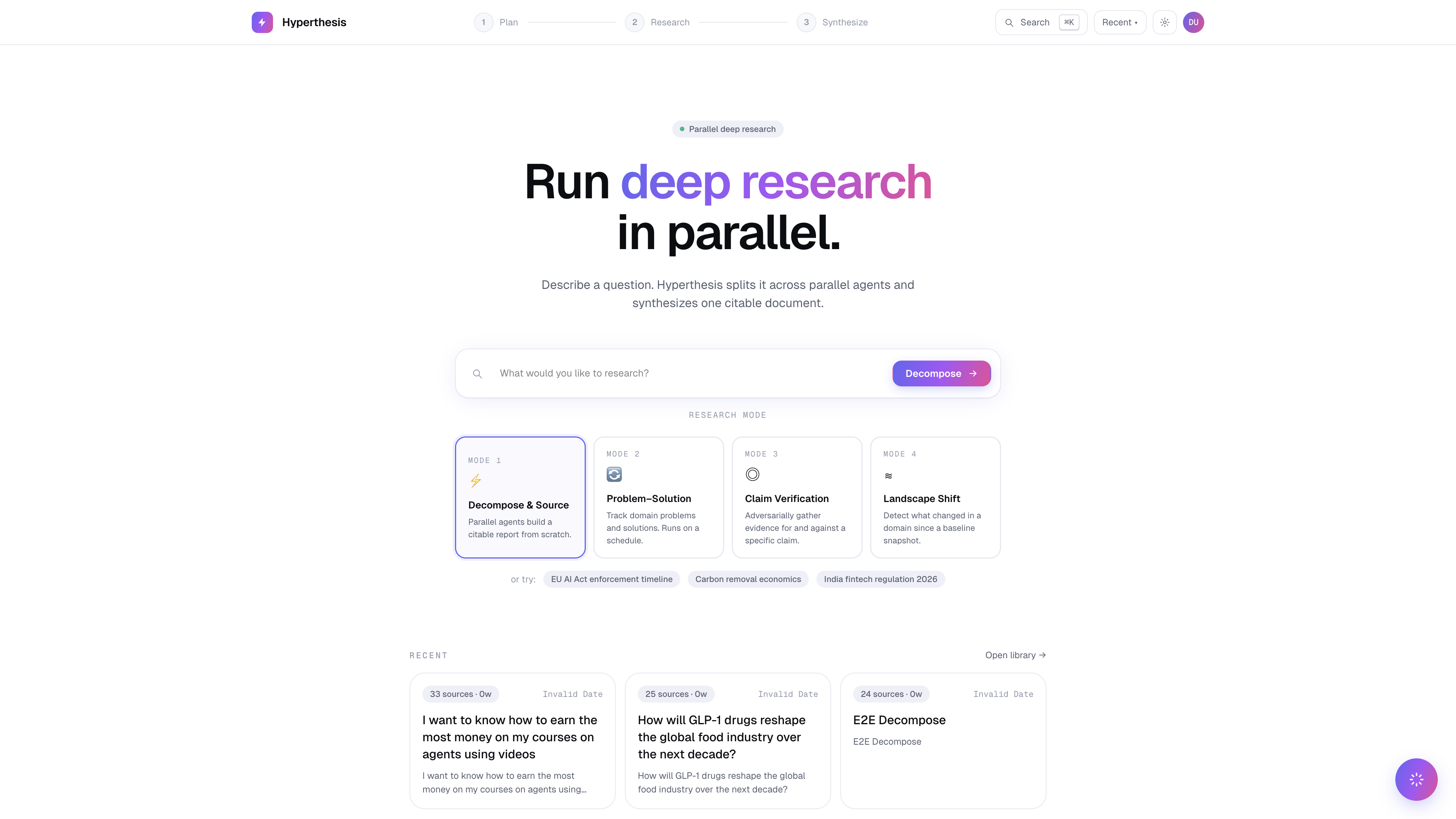
app.hyperthesis.io — Run deep research in parallel
Hyperthesis — Projects dashboard
82%
of analyst time spent collecting, not analyzing
IDC Industry Research
9/10
domain-expert checks of AI research find errors
r/LocalLLaMA survey
13%
of deep research citations are hallucinated
arxiv 2604.03173
3.5h
vs 12h per project with the right tools
Consultant Playbook
The research crisis

The tools are fast.
The output isn't trustworthy.

We analyzed 400+ forum threads, research papers, and professional surveys. The same six problems came up every time.

🔴

Hallucinated citations — at scale

Between 3% and 13% of citations in deep research agents don't exist. URLs that look real, papers never written, statistics from nowhere.

"It makes up sources that don't exist! Way too often it's just plain wrong."
— r/LocalLLaMA, 2025
⚠️

Confidence masks errors

AI research tools sound authoritative regardless of accuracy. Executives make real business decisions on content that sounds right but isn't.

"They're trained to sound confident. No hesitation, no 'I might be wrong'."
— r/ArtificialIntelligence
🟡

5-tool chaos every session

5–6 ChatGPT tabs, 2–3 Claude tabs, Gemini, Notion. Every session starts from scratch. The breakthrough from 2 weeks ago is gone forever.

"It's difficult to find the breakthrough in that ONE chat, 2 weeks ago."
— r/ChatGPTPro
🔶

Insights vanish between sessions

No persistent memory. No shared library. Re-explaining context costs 10–15 minutes per switch. Past breakthroughs are lost.

"We completely forgot where we left off, causing us to miss insights."
— r/ChatGPTPro
🔵

Surface synthesis, not real insight

Wide summaries, not deep analysis. Can't weight sources by recency or authority. Confuses blog posts with peer-reviewed research.

"What we have now is essentially a thorough summary of a long CoT."
— r/LocalLLaMA
🛡️

You can't stake your reputation on it

Consultants can't deliver it to clients. Journalists can't publish it. Academics face retractions. No audit trail to defend a position.

"Attorneys have been sanctioned. Papers retracted. The stakes are real."
— ACL 2025
The methodology

Research that earns trust

The way an expert analyst would — systematically, with primary sources, every claim verified before it reaches you.

1

Define the question

Paste your research question or brief. Hyperthesis scores and structures it into a formal strategy before a single query runs — eliminating "garbage in, garbage out."

Brief builderPre-execution scoringScope definition
2

Multi-iteration entity research

The agent decomposes your question into entities and sub-questions. Breadth first, then depth — targeting specific gaps. Stops when it has enough.

Entity graphBreadth → DepthGap detection
3

Citation verification on every source

Every URL checked for liveness. Every claim mapped to its source. Source quality scored by domain authority, recency, and type.

Live URL checkClaim mappingSource scoring
4

Structured report, not a dump

Output formatted for your deliverable — analyst report, literature review, competitive briefing. Every finding linked. Every section auditable.

TemplatesInline citationsExport PDF / Notion
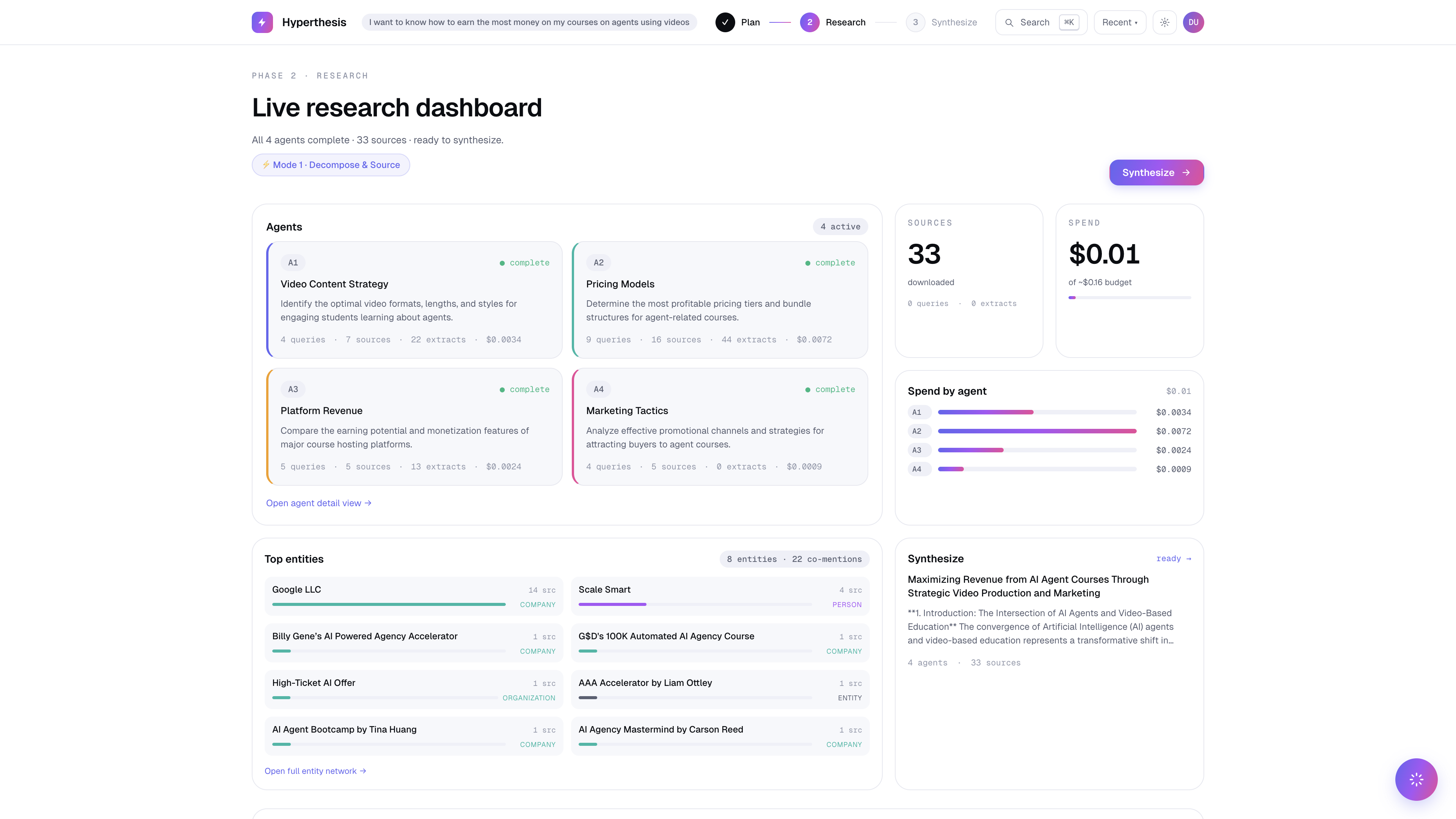
app.hyperthesis.io / projects / 31 — Live research dashboard
Hyperthesis — Live research dashboard
Research modes

One question. Four ways to answer it.

Different research questions need different strategies.

01
🔭

Decompose & Source

Broad research explored systematically. Breadth first, then depth. Full structured report with entity graph and inline citations.

Output: 2,000–5,000 word report · Entity graph · Verified source list
02
🔄

Problem–Solution Tracking

Monitor a domain over time. Maintains a living registry of open problems, candidate solutions, and validation states.

Output: Living registry · Solution timeline · Change alerts
03

Claim Verification

Verify a specific assertion before it goes into a deliverable. Returns a verdict with full evidence chain.

Output: Verdict · Evidence chain · Confidence score
04

Competitive Intelligence

Structured analysis of competing products, companies, or approaches. Tracks each against defined criteria.

Output: Competitor profiles · Attribute scorecard
Honest comparison

How does Hyperthesis compare?

We ran the same research question through all four tools.

CapabilityHyperthesisChatGPTPerplexityGemini
Citation URL verification Live, every sourcePartialPartial
Claim-to-source mapping Every claim linked List at end Inline
Source quality scoring Authority + recency
Research memory / library Persistent, searchablePartial
Multiple research modes 4 modes
Team knowledge sharing Shared library
Entity graph Full map
Who uses Hyperthesis

Built for people whose reputation is on the line

💼
Strategy Consultant
McKinsey, BCG, boutique firms, solo operators
Pain before Hyperthesis
×10–12 hours per project on research alone
×Can't trust AI output in client deliverables
×30-tab sessions, notes scattered everywhere
After Hyperthesis

"Turn a 10-hour research sprint into a 3-hour deliverable — with every claim sourced."

📰
Investigative Journalist
Newsrooms, freelancers, fact-checkers
Pain before Hyperthesis
×AI tools make verification harder, not easier
×Hallucinated quotes attributed to real people
×Editor rejects anything without verified sources
After Hyperthesis

"Sourced research your editor will let through. Every claim linked to its original source."

🎓
Academic Researcher
PhD students, postdocs, policy analysts
Pain before Hyperthesis
×AI literature reviews have broken citations
×AI cites papers that say the opposite
×No distinction between preprint and peer-reviewed
After Hyperthesis

"Every citation verified against DOI. Source quality scored. An audit trail any reviewer accepts."

✍️
Knowledge Worker
Freelance writers, grant writers, content teams
Pain before Hyperthesis
×3h domain ramp-up per project, unbilled
×Cognitive overload for every new field
×AI slop output kills credibility with clients
After Hyperthesis

"Stop absorbing research costs. Become a temporary expert in 30 minutes."

What users say

Research they can actually defend

★★★★★
"I used to spend 3 hours verifying what ChatGPT gave me. Hyperthesis cut that to 20 minutes. The citation verifier alone is worth the subscription."
MK
Marta K.
Senior Strategy Consultant, Munich
★★★★★
"The research library is what sold me. 40+ projects and I can search across all of them. Perplexity gave me amnesia — Hyperthesis remembers everything."
JL
James L.
Senior Reporter, Tech desk
★★★★★
"Every citation links to the DOI. I can see exactly which paper supports which claim. It's the difference between a tool and a co-researcher."
AS
Dr. Ananya S.
Postdoctoral Researcher, UCL
★★★★★
"Before Hyperthesis, I'd spend half the day understanding the domain. Now I have a structured briefing in 15 minutes and spend the rest actually writing."
TC
Tomáš C.
Freelance Technical Writer
★★★★★
"The Problem–Solution Tracking mode is genuinely unique. One alert alone saved us from recommending an approach that had just been debunked."
RP
Rachel P.
Head of Research, Biotech VC
★★★★★
"Our 6-person team shares one workspace. No more 'did anyone research X?' — the answer is always yes, and it's searchable."
SH
Sarah H.
Research Lead, Policy Institute
McKinsey & CoReutersUCLSiftedEYNatureOliver Wyman
Pricing

Pay for what you use.
No subscriptions. No surprises.

💡
How credits work
Hyperthesis runs on a credit balance, not a monthly subscription. Top up when you need to — no recurring charge, no waste. Each deep research run uses credits based on actual scope. Most users spend around $10/month, covering approximately 20–30 deep research sessions. That estimate is on the higher end — shorter runs cost less. Larger packs include bonus credits that never expire.
Free
$0
10 free runs
No card needed to start
Get started, no commitment
  • Decompose & Source mode
  • Citation verification
  • Entity graph
  • Advanced modes
Start free
Most popular
Starter
$10
$10 credit balance
≈ 20–30 deep research sessions
Approx. — shorter runs cost less
  • All 4 research modes
  • Citation verification
  • Personal knowledge library
  • Export PDF / Notion / Word
Add $10 →
Value
$25
+$5 bonus → $30 credits
≈ 60–90 deep research sessions
20% bonus. Best for weekly research.
  • All 4 research modes
  • Citation verification
  • Knowledge library
  • Team sharing (up to 3)
Add $25 →
Power
$50
+$15 bonus → $65 credits
≈ 130–195 deep research sessions
30% bonus. For heavy users and teams.
  • All 4 research modes
  • Shared team library
  • Priority support
  • API access (beta)
Add $50 →

Credits never expire. Enterprise pricing available — contact us.

Questions

Common questions

How is this different from ChatGPT Deep Research?
ChatGPT produces a report with a source list. Hyperthesis maps every claim to its specific source, verifies every URL is live, scores source quality, and stores everything in a persistent knowledge library.
Does it actually reduce hallucinations?
Yes — through citation verification. Every source URL is checked for liveness. Every claim is mapped and flagged if unverifiable. We catch it before it reaches your report.
Why credits instead of a subscription?
Because unpredictable bills are their own pain point. Credits mean you pay for what you actually use. No monthly charge if you're quiet, no cap if you're in a busy research period.
How much does one research run cost?
Most runs fall between $0.30 and $0.80 in credits. A $10 top-up covers approximately 20–30 runs. Shorter queries (Claim Verification) cost less; long multi-iteration runs cost more.
What is the knowledge library?
Every research run is indexed and searchable. Search across all past projects by keyword, entity, or date. Team plans share one library so colleagues build on each other's work.
Do credits expire?
No. Your credit balance never expires. Top up once and use it whenever you need it.
Can I export the reports?
Yes — PDF with inline citations, Word/DOCX, Notion pages, and plain Markdown. Enterprise plans receive structured JSON via API.
How long does a research run take?
Standard runs: 4–20 minutes. Claim Verification: under 3 minutes. Problem–Solution Tracking runs async and notifies you when done.
Get started

Stop verifying. Start using.

10 free research runs. No card. Verified citations from the first session.

10 free runs · No credit card · Credits never expire